

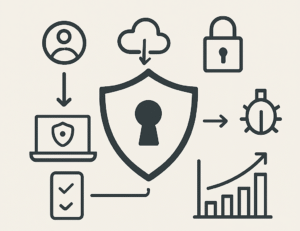
In today’s interconnected business world, the question isn’t whether your organization needs a robust cybersecurity strategy, but whether that strategy can evolve and expand at the same pace as your business itself. From agile startups experiencing rapid growth to established enterprises navigating digital transformation, the threat landscape is a moving target. Crafting a security framework that not only protects current assets but also seamlessly scales to accommodate new technologies, increasing data volumes, and an expanding workforce is no longer a luxury; it is a fundamental requirement for resilience and sustained success. A static defense in a dynamic environment is, by definition, a weakening one, leaving organizations vulnerable as they grow.
The Dynamic Imperative: Why Scalable Security Matters
The digital realm is in a constant state of flux. New technologies emerge, business models adapt, and critically, cyber threats become more sophisticated and pervasive. Consider the exponential growth in cloud adoption, the proliferation of IoT devices, and the shift towards remote or hybrid workforces, all of which expand an organization’s attack surface dramatically. Relying on piecemeal solutions or a strategy designed for yesterday’s threats creates a perilous gap. Research consistently indicates that the average cost of a data breach continues to climb, highlighting that inadequate, non-scalable security isn’t just a technical oversight; it’s a significant financial and reputational liability.
A truly scalable cybersecurity strategy anticipates this evolution. It acknowledges that what works for a team of 50 people might crumble under the weight of 500 or 5,000, especially if those additional users bring new applications, devices, and data streams into the fold. Without a scalable approach, growth can inadvertently lead to increased vulnerability, turning business success into a magnet for malicious actors. The goal, therefore, is to build a defense mechanism that not only withstands current pressures but possesses the inherent flexibility and intelligence to adapt and strengthen as your organization’s digital footprint expands.
Core Pillars of a Resilient Cybersecurity Strategy
Before any strategy can scale, it must first be firmly rooted in foundational principles. These pillars provide the bedrock upon which adaptability and growth can be built securely, ensuring that as your organization expands, its defenses remain robust and effective against an ever-evolving threat landscape.
Understanding Your Attack Surface
You cannot protect what you do not know you have. A comprehensive understanding of your attack surface involves meticulously inventorying all assets, including hardware, software, cloud instances, mobile devices, and third-party integrations. This means continuous monitoring, not just periodic scans, to identify new entry points or vulnerabilities as they arise. The increasing reliance on cloud infrastructure and supply chain partners means that your attack surface extends far beyond your physical perimeter, demanding constant vigilance and discovery.
Risk Assessment and Management
Once assets are mapped, the next step is to assess the risks associated with them. Not all vulnerabilities pose the same level of threat; some are critical, others less so. Effective risk management involves prioritizing vulnerabilities based on their potential impact and exploitability, defining acceptable risk thresholds, and allocating resources accordingly. This isn’t a one-time exercise but an ongoing process that informs resource allocation and strategic decisions.
Layered Defenses: The “Defense in Depth” Principle
Relying on a single security control is akin to having only one lock on your front door. Defense in depth advocates for multiple, overlapping security layers, so if one fails, another is there to catch it. This includes network security (firewalls, intrusion detection), endpoint protection (antivirus, EDR), data encryption, and, crucially, identity and access management. Each layer adds an additional barrier, significantly increasing the effort and complexity for an attacker to achieve their objectives.
Incident Response and Recovery Planning
Despite the best preventative measures, breaches can and do occur. A well-defined incident response plan is critical for minimizing damage, ensuring business continuity, and facilitating rapid recovery. This plan should outline clear roles and responsibilities, communication protocols, forensic procedures, and recovery steps. Practicing this plan through simulations ensures that your team is prepared to act decisively when a real incident unfolds.
Building for Growth: Scaling Your Cyber Defenses
With foundational elements in place, the focus shifts to how these defenses can grow alongside your business without becoming a bottleneck or an overwhelming drain on resources. This evolution is crucial for maintaining agility and ensuring that security remains an enabler, not an inhibitor, of innovation and expansion.
Embracing Automation and AI
Manual security operations simply cannot keep pace with the scale and speed of modern threats or the volume of data generated by growing organizations. Automation, powered by artificial intelligence and machine learning, becomes indispensable. These technologies can process vast amounts of security data, detect subtle anomalies, and even respond to threats autonomously, significantly reducing the burden on human teams. Platforms leveraging AI and machine learning, like those developed by AMSEC, can analyze telemetry from across the entire attack surface, providing predictive insights and accelerating response times.
Unified Visibility and Management
Many organizations find themselves managing a patchwork of disparate security tools, each with its own dashboard and reporting. This siloed approach leads to blind spots, operational inefficiencies, and delayed response. A scalable strategy demands a unified platform that integrates various security functions, offering a single pane of glass for comprehensive visibility and streamlined management. This consolidation eliminates complexity and ensures that security teams can correlate events across different domains, fostering a truly holistic defense.
Dark Web Intelligence and Threat Hunting
Proactive defense involves more than just reacting to known threats. It means actively seeking out indicators of compromise and understanding the adversarial landscape. Incorporating dark web intelligence allows organizations to monitor for leaked credentials, planned attacks, or discussions targeting their brand, enabling pre-emptive action. Threat hunting, using contextual data and expert analysis, actively searches for subtle signs of intrusion that automated systems might miss, elevating your security posture from reactive to predictive.
Identity-Centric Security
As organizations grow, so does the number of users, devices, and access points. An identity-centric approach, often built on Zero Trust principles, assumes that no user or device can be automatically trusted, regardless of their location. Every access request is rigorously verified, minimizing the risk of unauthorized lateral movement within the network. This approach is inherently scalable because it focuses on protecting access to resources, rather than just perimeter defense, making it robust for expanding workforces and increasingly complex access scenarios.
Here is a comparison of traditional versus scalable cybersecurity approaches:
| Aspect | Traditional Approach | Scalable Approach |
|---|---|---|
| Coverage | Fragmented, point solutions for specific threats | Holistic, continuous, and adaptive across the entire attack surface |
| Management | Manual, resource-intensive, multiple dashboards | Automated, unified, AI-driven, single platform visibility |
| Threat Detection | Reactive, signature-based, periodic scans | Proactive, real-time, behavioral analysis, dark web intelligence |
| Response | Slow, manual correlation, often after damage is done | Automated, rapid, pre-emptive, integrated incident response |
| Resource Efficiency | High operational overhead, specialized staff needed | Optimized, leverages AI to augment human teams, cost-effective growth |
| Adaptability | Stiff, struggles with new technologies or growth | Flexible, built to evolve with business and threat landscape changes |
The AMSEC Advantage: Simplifying Scalable Security
Building a truly scalable cybersecurity strategy can seem daunting, particularly when balancing growth with resource constraints. This is precisely where a unified, intelligent platform becomes invaluable. AMSEC, formed through the merger of RedRok and AMSYS, brings together decades of experience in IT infrastructure and cutting-edge security to offer a solution designed to meet these challenges head-on. Our AI-powered platform simplifies and strengthens cyber defense for organizations of all sizes, from agile enterprises to demanding MSPs and MSSPs.
AMSEC integrates continuous attack surface monitoring, internal vulnerability scanning, dark web intelligence, identity management, and real-time threat response into a single, unified platform. This comprehensive approach means that as your business expands, so too does your protection, without the added complexity of managing multiple disjointed tools. Our platform provides the clarity, speed, and precision needed to navigate a rapidly evolving threat landscape, empowering your teams to focus on strategic initiatives rather than managing security sprawl.
Practical Steps to Implement Your Scalable Strategy
Embarking on the journey to a scalable cybersecurity strategy requires a structured approach. By following these actionable steps, organizations can systematically enhance their security posture and ensure their defenses are well-prepared for future growth and evolving threats.
Conduct a Comprehensive Security Audit
Begin with a thorough audit of your current security posture, identifying strengths, weaknesses, and compliance gaps. This establishes a baseline and highlights areas requiring immediate attention or future investment. Understanding your current state is the first step towards defining your desired future state.
Prioritize and Automate
Focus your efforts on the highest-risk areas first. Look for opportunities to automate routine security tasks, such as vulnerability assessments, patch management, and initial incident triage. Automation frees up valuable human resources to address more complex, strategic challenges.
Foster a Security-Aware Culture
Technology alone is insufficient. Your employees are both your first line of defense and potentially your greatest vulnerability. Implement ongoing security awareness training, encourage reporting of suspicious activities, and foster a culture where security is everyone’s responsibility, not just IT’s.
Partner with Expertise
Leveraging external expertise can be a game-changer, especially for organizations with limited in-house security teams. Collaborating with trusted security vendors or managed security service providers (MSSPs) can provide access to cutting-edge technology, specialized knowledge, and round-the-clock monitoring. For businesses seeking a comprehensive computer security service that evolves with them, exploring integrated platforms offers a strategic advantage.
Frequently Asked Questions About Scalable Cybersecurity
Q1: What does “scalable cybersecurity” truly mean for an organization?
Scalable cybersecurity refers to a security strategy and infrastructure designed to grow and adapt seamlessly with an organization’s expansion. It means that as your business acquires more users, devices, data, and adopts new technologies, your security defenses can expand in coverage and capability without introducing bottlenecks, increasing vulnerabilities, or requiring a complete overhaul. It’s about building a defense mechanism that is inherently flexible and intelligent, strengthening as your digital footprint expands.
Q2: Why is traditional, static security insufficient for growing businesses today?
Traditional, static security often relies on piecemeal solutions and a perimeter-focused defense designed for a fixed environment. In today’s dynamic business world, with rapid cloud adoption, remote work, and an ever-evolving threat landscape, such an approach quickly creates perilous security gaps. Growth inadvertently increases the attack surface, and without a scalable strategy, a static defense becomes a weakening one, leaving organizations vulnerable to sophisticated threats and significant financial and reputational liabilities.
Q3: How does AMSEC’s platform help organizations achieve scalable security?
AMSEC’s AI-powered platform provides a unified, intelligent solution by integrating continuous attack surface monitoring, internal vulnerability scanning, dark web intelligence, identity management, and real-time threat response into a single pane of glass. This comprehensive approach simplifies management, eliminates blind spots, and ensures that as your business expands, your protection grows with it. AMSEC leverages automation and AI to process vast amounts of data, detect anomalies, and accelerate response times, allowing teams to focus on strategic initiatives.
Q4: What are the core benefits of embracing automation and AI in a scalable cybersecurity strategy?
Automation and AI are indispensable for scalable cybersecurity because manual operations cannot keep pace with modern threats or data volumes. Their core benefits include significantly reducing the burden on human security teams by automating routine tasks, enabling real-time processing of vast amounts of security data, detecting subtle anomalies that humans might miss, and even autonomously responding to threats. This leads to faster threat detection, more efficient resource allocation, and a proactive security posture, providing predictive insights and accelerating incident response.
Q5: What is the Zero Trust principle and why is it important for scalable security?
The Zero Trust principle assumes that no user, device, or application can be automatically trusted, regardless of their location within or outside the network. Every access request is rigorously verified based on context, identity, and device posture before granting the least privilege access necessary. This identity-centric approach is crucial for scalable security because as organizations grow, so does the number of users and access points. Zero Trust minimizes the risk of unauthorized lateral movement, providing robust protection for expanding workforces and increasingly complex access scenarios by protecting access to resources rather than just the traditional network perimeter.
Conclusion: Your Evolving Shield
Building a cybersecurity strategy that scales with your business is not a one-time project, but a continuous journey of adaptation and improvement. It demands a proactive mindset, a commitment to unified visibility, and the judicious application of intelligent automation. By embracing foundational principles and integrating advanced solutions like those offered by AMSEC, organizations can transform their cyber defense from a static barrier into a dynamic, intelligent shield. This approach not only safeguards your assets against present threats but also ensures your resilience and growth in the face of an ever-changing digital future, allowing your business to innovate and expand with confidence.